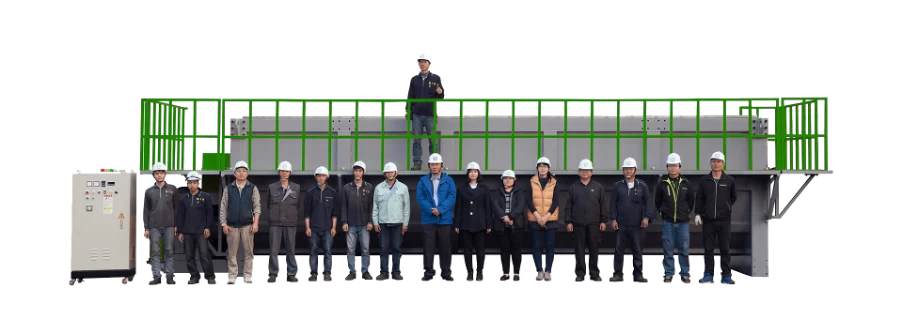
As Taiwan's largest-capacity manufacturer of industrial horizontal ribbon mixers, Geording Machinery has completed a 26,500-liter precision mixing system engineered for high-throughput plastics recycling plants. When processing regrind, flake, additive packages, and compound formulations at scale, uneven blending does not stay contained in the mixer. Instead, it surfaces downstream as unstable melt flow, inconsistent extrusion output, and pellet batches that drift off specification.
The Physics of Large-Batch Inconsistency in Recycled Resins
Material homogeneity breaks down at scale because a larger batch means blend components travel farther to reach uniform distribution, and recycled feedstock makes that distance harder to close than virgin resin does. Recycled resin carries more lot-to-lot variability than virgin material to begin with, since it draws from a wider range of source grades — each batch also carries its own melt flow index (MFI) and density variance, on top of differing performance characteristics.
That variability directly affects dimensional consistency and mechanical properties downstream, which means an uneven blend entering the mixer comes out of the extruder uneven as well. For recyclers running regrind, flakes, and additive packages through the same batch, the mixing stage is often the last point in the line where that inconsistency can still be corrected before it reaches the extruder.
Vertical Silos vs. Horizontal Ribbon Mixers: The Engineering Trade-Off
In high-volume resin handling, vertical silos rely mainly on gravity-assisted recirculation, which makes them efficient for bulk storage-and-blend work. Horizontal ribbon mixers take the opposite approach: active axial-and-radial counter-flow enforces tighter uniformity, but that mechanical choice typically caps how large the vessel can get. This highlights the standard engineering trade-off: silo mixers for volume, ribbon mixers for precision, and rarely both at once.
| Equipment Class | Primary Flow Mechanism | Typical Homogeneity | Scaling Constraint | Best Application |
|---|---|---|---|---|
| Vertical Blending Silo | Gravity drop & screw recirculation | Moderate (bulk dispersion) | Height / floor footprint | Virgin resin blending & buffer storage |
| Standard Ribbon Mixer | Counter-rotating helical ribbons | High (micro-dispersion) | Max volume capped (<15,000L) | Additives, color masterbatch, high-precision blends |
| Geording 26,500L Custom Mixer | Engineered dual-ribbon counter-flow | High precision across 26.5 m³ | Torque & tip-speed engineered | High-throughput PCR/PIR flake & regrind blending |
A 26,500L capacity sits well above where horizontal ribbon designs typically operate, which is exactly why holding "precision mixing" at this volume is a meaningful engineering achievement. The mixer relies on an inner-and-outer helical ribbon arrangement that drives axial and radial flow; the engineering challenge is keeping that flow pattern intact once the trough reaches this scale.
Engineering Challenges at 26,500 Liters: Torque, Tip Speed, and Power
Three variables that pose minimal design challenges at small volumes become critical limiting factors at 26,500L:
-
Heavy-Duty Reducer with Enhanced Safety Factor: When processing regrind, film flake, and compound additives, material tends to interlock and tangle, generating substantial startup resistance and shock loading. Geording specifically raises the drive system’s safety factor by specifying a custom heavy-duty reducer paired with a high-rigidity main shaft design — enabling the unit to handle the instantaneous high torque of a full-load startup while significantly extending the equipment’s continuous-operation service life.
-
Full Interior Polishing for Zero Dead Zones: Material residue and cross-contamination are the biggest challenge in large horizontal mixers. Geording applies high-spec full polishing to both the trough’s interior walls and the ribbon blades, minimizing surface roughness. Beyond substantially reducing flow resistance and eliminating mixing dead zones, this also makes material changeovers and trough cleaning far faster and easier.
-
Optimized Blade Tip Speed for Gentle, Efficient Mixing: As vessel diameter increases significantly, blade tip speed rises proportionally. To prevent excessive tip speed from causing frictional overheating and degradation of plastic flake, Geording optimizes the ribbon pitch angle and precisely controls rotation speed — lowering tip speed to gently protect material integrity while still maintaining excellent overall convective circulation efficiency.
As Taiwan’s manufacturing benchmark for extreme-capacity mixing equipment, Geording builds this equipment class in carbon steel (SS41) or stainless steel (SUS304), with standard drive power scaling from 5 horsepower (HP) on compact 400L units up to a massive 75–125 HP range at 35,000L. For custom capacities such as this 26,500L system, Geording calculates drive torque and structural reinforcement specifically against the client's material bulk density and abrasiveness, rather than defaulting to a catalog standard.
The same engineering discipline applies to paddle count and rotation speed: both are customized case by case. Heavy-duty horizontal mixer installations in demanding international markets like Japan reflect these engineering choices, enabling the 26,500L system to maintain the tight precision that smaller units deliver.
Proven in Heavy-Duty Commissioning: Inside Geording's Workshop
To verify mechanical stability, motor load balance, and counter-flow fluidization under real operating conditions, every custom mixing system undergoes comprehensive full-scale shop assembly and factory acceptance testing prior to dispatch.
Watch the 26,500L Huge Horizontal Mixer Factory Test Run on Facebook
Video Highlights: See the precision-machined SUS304 dual helical ribbon assembly in full rotation, showcasing continuous wall-wiping action, smooth material turnover, and heavy-duty structural integrity built for 24/7 continuous recycling operations.
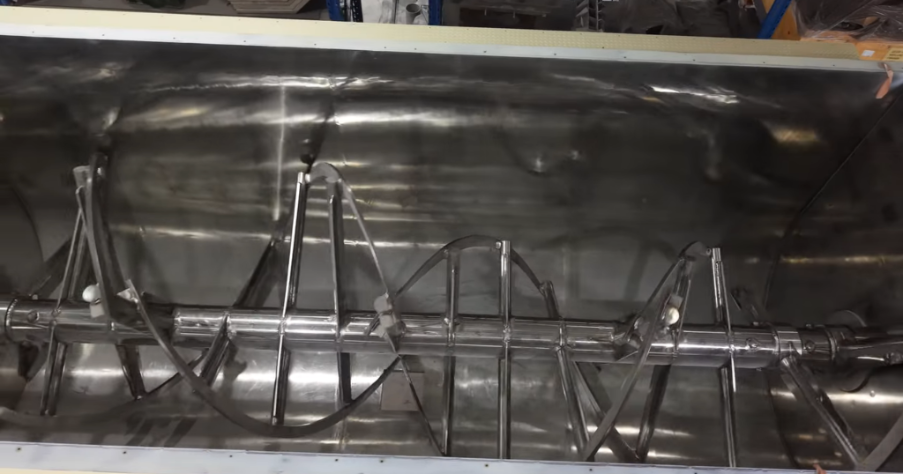
(Unlike gravity-fed vertical silos, horizontal ribbon mixers utilize active axial and radial counter-flow to achieve precision micro-dispersion across large batches.)
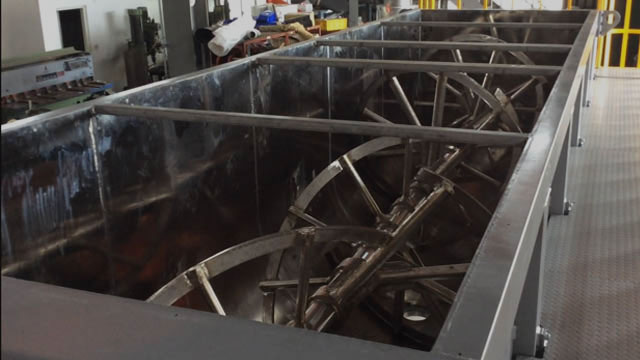
Bridging Capacity Gaps and Downstream Stabilization
Custom-Fit Machine Configuration: The Equipment Adapts to the Plant, Not the Reverse
Fixed catalog dimensions often leave customers caught in a bind when planning line layout — either the trough length runs up against column-spacing constraints, or the feed/discharge height doesn’t align with upstream and downstream equipment.
Geording’s engineering and manufacturing range spans from 400L up to Taiwan’s largest 35,000L, built on an understanding that every pelletizing plant has its own building structure and ceiling-height constraints. For the 26,500L system, Geording doesn’t just size the vessel to the client’s needs — motor-drive positioning, support-frame height, feed/discharge port placement, and maintenance-access clearance are all custom-configured, so the large-format unit delivers maximum operational value within the plant’s available footprint.
Consistent pre-treatment mixing delivers steadier feeding into the pelletizer and pellets that hold to specification across a full production run. Mixing rules developed for recycled polypropylene streams show that controlling blend ratios upstream keeps melt flow rate (MFR) within target ranges even when incoming recyclate fluctuates (Polymers, 2022).
In practice, recyclers running this level of pre-treatment consistency see fewer melt-flow-related line stoppages per shift and higher first-pass yield on quality specs.
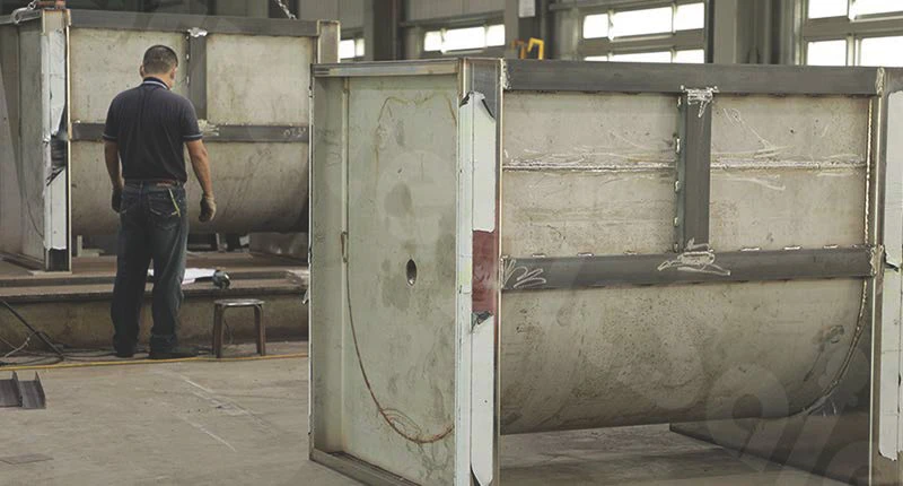
(High-grade polished interior walls and dual helical ribbons eliminate dead zones and minimize cross-contamination during resin changeovers.)
Frequently Asked Questions (FAQ)
What makes Geording unique among horizontal mixer manufacturers?
Geording is Taiwan's premier manufacturer with the largest design and production capacity for horizontal ribbon mixers, capable of scaling single-vessel systems up to 35,000 liters with custom engineering at intermediate sizes like 26,500L.
What is the maximum throughput for Geording's 26,500L ribbon mixer?
Throughput depends on material bulk density and required retention time. For typical post-consumer plastics (bulk density approximately 400–600 kg/m³), a 26,500L batch processes approximately 10 to 15 metric tons per cycle, easily scaling to multi-ton hourly production lines.
How does Geording prevent thermal degradation during large-batch mixing?
By maintaining a low RPM profile and optimizing the outer ribbon's radial clearance, Geording minimizes frictional shear heat. Optional cooling jackets can also be integrated directly into the trough.
Can the 26,500L mixer handle abrasive additives such as calcium carbonate or glass fiber?
Yes. For abrasive additives and modified compounds, Geording specifies all-SUS304 contact surfaces, tungsten-carbide hard-facing welded onto the ribbon blade edges, and dust-resistant multi-stage shaft seals — substantially extending service life.
Plan Your High-Volume Recycling Line with Geording
Evaluating large-capacity mixing equipment requires aligning vessel volume, bulk density, drive torque, and downstream extrusion flow. Work with Taiwan’s premier mixing machinery engineers to configure the optimal system for your plant:
Schedule a Consultation with Geording's Turnkey Plant Specialists
Discuss seamless line integration, automated pneumatic bottom-discharge gates, cooling/heating jackets, and full pelletizing downstream setups.