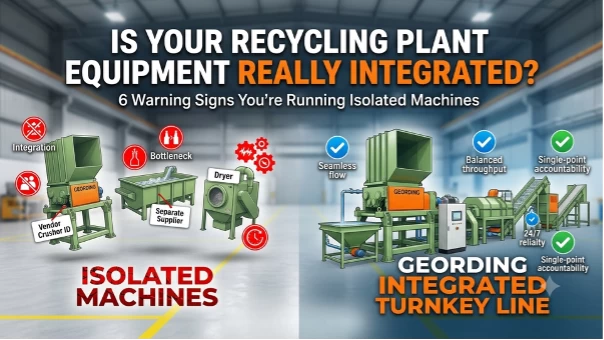
If your crusher, washing equipment, and dryer came from three different suppliers, you don't have an integrated line — you have three standalone machines that just happen to sit next to each other.
These issues usually leave a trail: mismatched throughput between stages, downtime nobody can quite explain, no single point of contact when something breaks. The six warning signs below can help you spot the bottleneck before the next shutdown causes serious losses.
Sign 1: Different Vendors, Different Stages — Every Call Turns Into Finger-Pointing
When the crusher, the washing tanks, and the dryer each came from a different supplier, no single vendor can tell you why the whole line is underperforming; each one can only speak to their own piece of it. Every support call starts the same way: "That's not our equipment, you'll need to check with the other supplier."
Sign 2: Stage Throughput Doesn't Match — One Stage Runs Dry While the Next Chokes
A crusher sized for one throughput feeding a washing tank or dryer sized for another means one stage runs dry while the next chokes. This is one of the most common symptoms of equipment bought stage-by-stage rather than designed as a line: nobody sized the whole system, or calibrated it, against a single target output.
Sign 3: "Warranty" Means Three Phone Calls, Not One
When a fault touches both the stage before and after it, you end up spending real time coordinating between vendors just to figure out who's responsible. A single-supplier system removes that ambiguity from the start, because one vendor owns the line's end-to-end performance.
Sign 4: Contamination or Moisture Keeps Slipping Through
You've adjusted the flotation tank settings, added an extra wash cycle, extended drying time — and pellet quality still isn't consistent. This usually isn't a single piece of equipment failing; it's a sign that the stages were never tuned and calibrated against each other as one process from day one.
Sign 5: Every Fix Is a Workaround, Not a Repair
On an unintegrated line, problems tend to cascade: the crusher falls behind what washing needs, washing can't keep pace with the feed coming from the stage before it, and eventually someone has to stop the line by hand.
Without automated interlocks tying the stages together, the system can't automatically respond to feed fluctuations. The common workaround is running an extra wash cycle, extending drying time, or manually re-sorting before the pelletizer. These keep the line limping along, but they're only compensating for an upstream flaw — driving up labor hours and ruling out any real chance of unattended 24-hour operation.
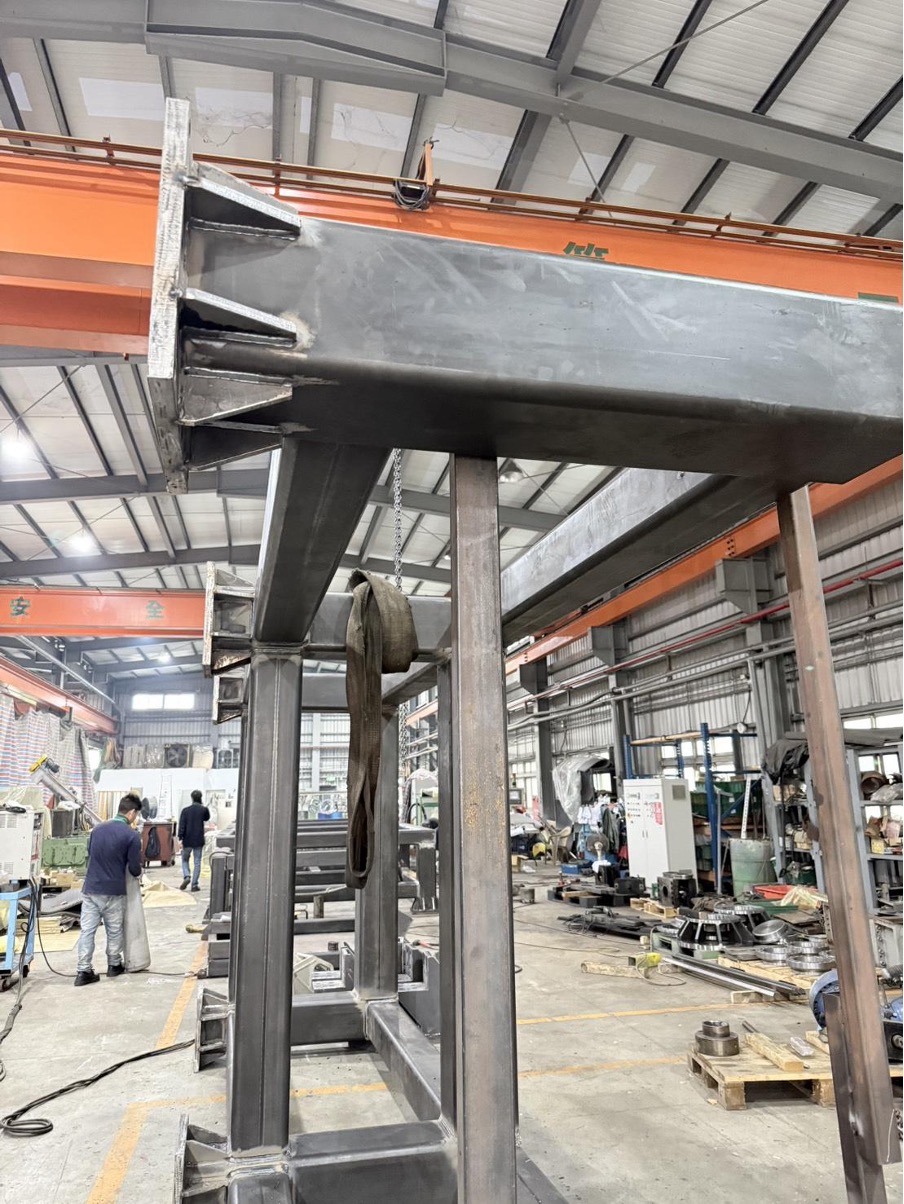
(Heavy-duty steel beams and precision-welded gussets engineered by Geording to deliver maximum structural stability for continuous, high-load operations. )
Sign 6: You've Stopped Tracking Downtime Because "That's Just How the Line Runs"
The most damaging outcome of failed integration is normalizing the abnormal. When unplanned downtime stops being flagged as a problem and instead becomes the daily default — to the point nobody remembers the last time the whole line ran a clean shift — that's no longer a maintenance issue. It's a system design issue from day one.
What Changes Under Geording's Single-Supplier Model?
None of this is unique to any one brand of equipment — it's what happens whenever a crushing-washing-drying line gets assembled after the fact instead of designed as one system from the start.
Geording has completed more than 480 installations worldwide since the company was founded in 2004, and has handled plenty of cases like this: take a major recycler in Southeast Asia, whose existing washing line fell short of its target throughput and disrupted delivery schedules. Geording ran an on-site diagnosis, redesigned the equipment layout and workflow into one coordinated system, and the line returned to stable operation. Geording's turnkey installation in Japan follows the same logic: one supplier, one line, one point of accountability from layout through startup.
Our rule is simple: if the line isn't fully integrated and hasn't completed full run testing before shipment, it doesn't ship. The goal behind that is just as simple — once the equipment is handed over, the client should barely need to contact us again, aside from the occasional parts order.
Under this model, every stage's throughput is sized against the same target. When something goes wrong, one team troubleshoots the whole line — no finger-pointing between stages. (For the full single-supplier line specifications, see Geording's crushing, washing, and drying line page.)
Geording’s fully integrated crushing, washing, and drying line installed in Japan, demonstrating seamless workflow and single-supplier turnkey integration.
Let's Break the Cycle of Inefficient Operation
If two or more of these six warning signs describe your current line, talk to Geording's team about your throughput and material stream, and we'll help you plan the right integration approach.