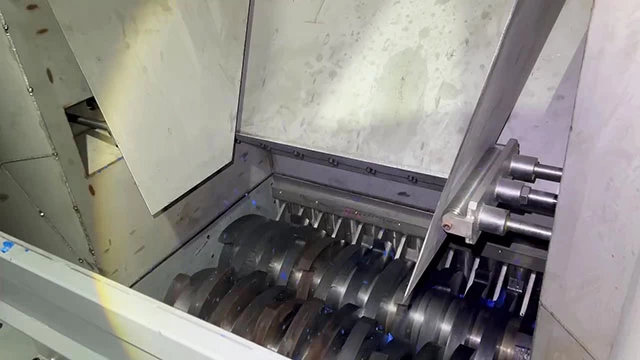
A specialist recycler serving the semiconductor industry had to destroy hydrochloric acid drums together with their residue. A standard drum shredder would not last on that job, so we built a complete anti-corrosion line.
Here is the project at a glance:
- Customer: A specialist recycler serving semiconductor manufacturers, including wafer foundries
- Material: Large hydrochloric acid drums still holding strong acid and alkali residue
- Scope: A complete line covering shredding, washing and pelletizing
- Construction: Customized structure and materials, using SUS stainless steel and other anti-corrosion materials
- Status: Delivered and running in production
The Challenge: Acid Drums That Must Be Destroyed with Their Residue
Semiconductor fabs require their recyclers to destroy used chemical drums together with the liquid left inside, so the drums can never be reused. Chip manufacturing relies on a wide range of specialty chemicals, and the rule protects both confidentiality and safety.
For this recycler, that requirement created two problems. The strong acid and alkali residue made shredding and washing hazardous, and it caused severe corrosion that quickly damaged ordinary recycling equipment. That ruled out a standard drum shredder.
Chemical drums are hard to process in their own right. Industrial drums have thick walls built to resist impact and chemical attack, which makes them harder to shred and melt than ordinary plastics. Their round shape also lets them slip and spin inside a standard shredder, causing jams and downtime.
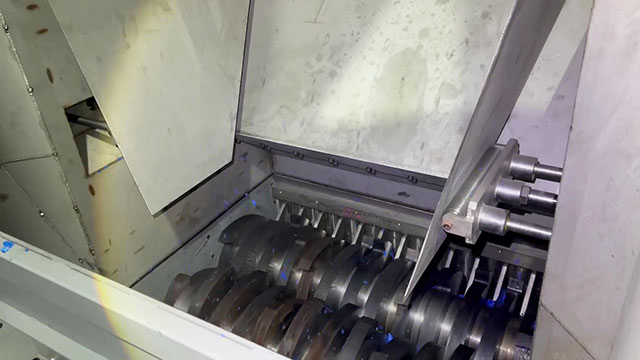
The cutting chamber of one of our twin shaft shredders.
The Solution: A Corrosion-Resistant Drum Shredder Line, from Shredding to Pelletizing
We customized both the structure and the materials of the drum shredder line, using SUS stainless steel and other anti-corrosion materials to make it more durable and safer to run.
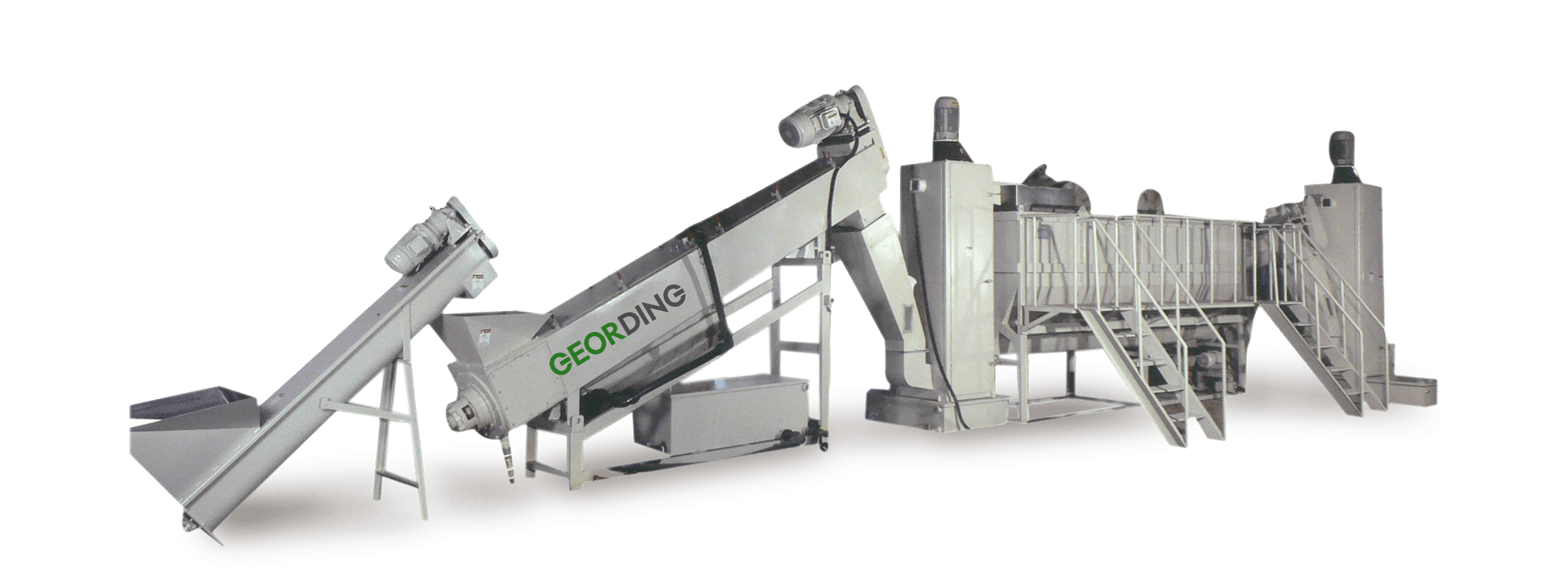
The drums go into our shredders with their residue still inside, so container and liquid are destroyed together. The shredded plastic then moves to a washing section based on our plastic washing lines, where the residue is cleaned off. From there it goes to a pelletizing machine, which turns the clean plastic into recycled pellets.
Chemical drum recycling lines are usually designed around these traits. The shredding stage has to grip the round drums securely and control output size, so the next stage receives consistent feed. Our Twin shaft shredder guide explains how shredders control output size. The washing stage uses stainless steel tanks and chemical-resistant seals, with multiple washing passes to remove stubborn residue. The same deep-cleaning principles apply in PET bottle recycling, where residual liquids and label adhesive have to be stripped away.
Pelletizing brings its own challenge. The HDPE grades used for chemical containers tend to have low melt viscosity and poor flow. A standard screw struggles to hold steady pressure, which hurts pellet quality. We design our own screws around the actual material, so even hard-to-melt HDPE melts evenly and produces uniform recycled pellets.
We plan the whole line ourselves, so the capacity of the shredding, washing and pelletizing stages is matched from the design stage. That avoids the usual problems of buying each stage separately, such as stages that cannot keep pace with each other and no single point of responsibility when something goes wrong. Learn more in warning signs of unintegrated recycling equipment.
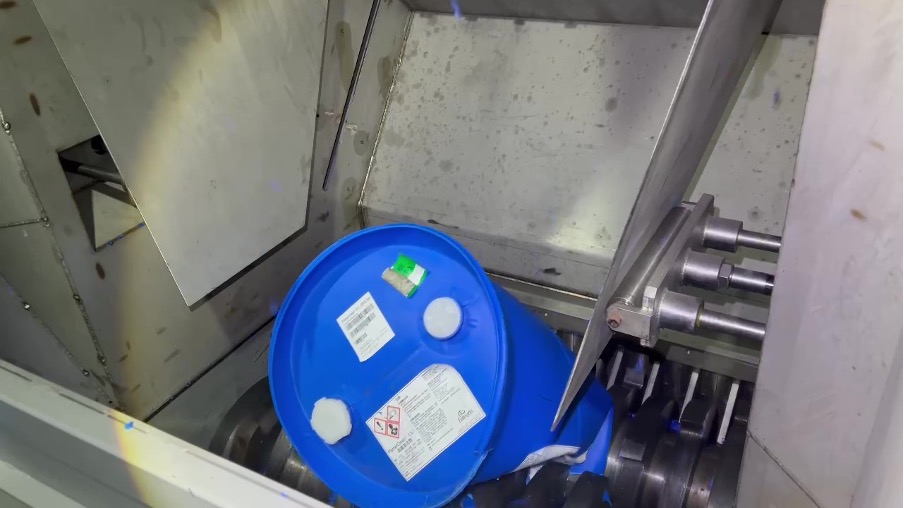
A plastic chemical drum being fed into a shredder.
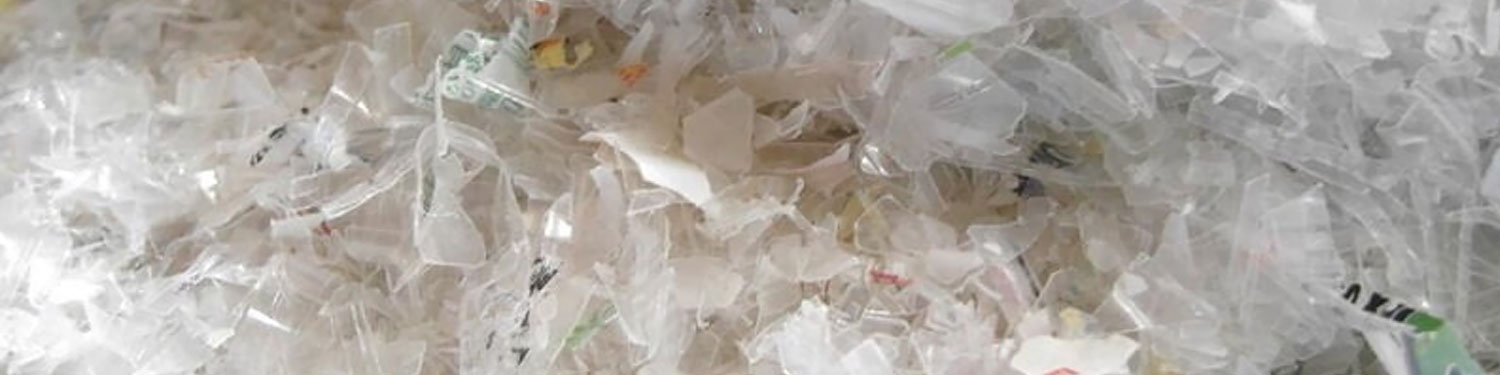
Plastic flakes after washing.
The video below shows one of our HDPE acid drum pelletizing lines in operation.
The Result: One Drum Shredder Line for Compliant Destruction and Recycled Pellets
The drum shredder line is now running in production at the recycler's plant. The fabs' destruction rule is met at the first step of the process, and the whole job happens under one roof. The plastic leaves the plant as recycled pellets instead of hazardous waste.
That is where the value of drum recycling lies: contaminated drums that cost money to dispose of become recycled HDPE that can be sold. We have built a similar line for the waste processing partner of a Japanese industrial cleaning company. Its drums had held degreasers and solvents and were classified as hazardous waste because of the residue. With triple-stage washing and a filtration-ready screw, the line cleans, melts and pelletizes the drums safely, and the recycled HDPE can be used in non-contact applications. Some lines can also add a smart monitoring module that tracks production status, energy use and emissions in real time, which helps recyclers prepare ESG and carbon audit data.

Recycled plastic pellets, the end product of a shredding, washing and pelletizing line.
Beyond Acid Drums: IC Trays, FOUPs and Electronics Trays
The same drum shredding equipment and technology can be extended to the confidential shredding and destruction of chip carriers such as integrated circuit (IC) trays and front opening unified pods (FOUPs). Plastic trays from electronic products, in materials such as extruded polystyrene (XPS) and polypropylene (PP), can also be shredded and extruded for reuse.
Related Experience: Crushing Battery Materials Safely
Acid drums are not the only hazardous material our crushing equipment handles. For battery material recycling, we delivered an automated crushing solution designed around safety. Crushing is the critical stage in battery recycling: handled poorly, it can oxidize the material and create a fire risk. Our solution keeps crushing conditions under tight control, and its high degree of automation cuts down on manual handling.
About GEORDING
We are a Taiwanese manufacturer that has designed and built recycling equipment in our own factory since 2004. Every machine goes through a live test run before it ships, and our machines have been sold to more than 29 countries. On turnkey projects, our support covers raw material analysis, process design, equipment installation and operator training. One example is the crushing, washing and drying line we installed on a turnkey basis in Japan. Read more in our company profile, or see what our after-sales service covers.
Plan Your Anti-Corrosion Drum Shredder Line with Us
If you are a recycler or environmental engineering team handling semiconductor waste, we would be glad to plan an anti-corrosion line for you. Tell us about the drums you handle and the chemicals they held, whether you need shredding only or the full line through pelletizing, and any destruction requirements your customers have set. Send those details through our contact form, and our team will get back to you.
Further Reading on Drum Shredding and Plastic Recycling
These articles and project pages go deeper into the equipment and processes in this case: