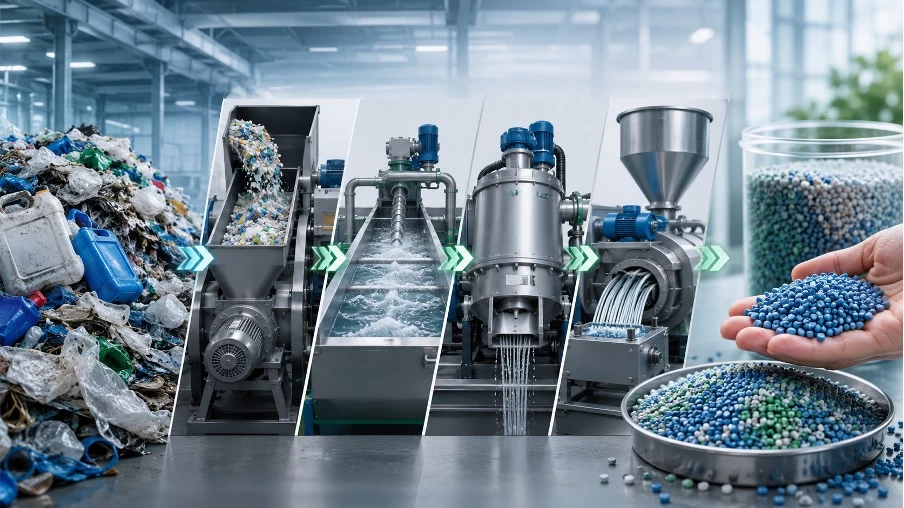
Plastic recycling is not simply about collecting waste plastic. It is a complete process that turns waste plastic into reusable raw material. In actual recycling operations, collected plastic materials usually go through sorting, crushing, washing, dewatering, drying, extrusion, and pelletizing before they can be processed into recycled pellets for reuse.
In recent years, the importance of the plastic recycling process has continued to grow due to circular economy initiatives, waste reduction policies, recycled material demand, and ESG-related requirements. For manufacturers and plastic recycling plants, selecting the right plastic recycling machine according to plastic type, contamination level, production capacity, and final application is essential for product quality and long-term production stability.
This article explains the basic process of turning waste plastic into recycled pellets, the equipment required at each stage, and the key points to confirm when planning a plastic recycling line.
In simple terms, the plastic recycling process turns waste plastic into reusable recycled pellets through sorting, crushing, washing, dewatering, drying, extrusion, and pelletizing. If the raw material is relatively clean, such as in-house production scrap, the process may be simplified. If the material contains mud, oil, labels, or moisture, washing, dewatering, and drying equipment are required to ensure stable extrusion and pelletizing.
Key Takeaways
- The plastic recycling process usually includes collection and sorting, crushing and grinding, washing, dewatering and drying, extrusion, pelletizing, cooling, and storage.
- Whether waste plastic needs washing depends on material source, contamination level, moisture content, and the final application of the recycled pellets.
- PP, PE, HDPE, and plastic film can all be recycled, but each has different processing requirements for crushing, washing, dewatering, feeding, and extrusion.
- When planning a plastic recycling line, manufacturers should not evaluate only single machines. The capacity balance among the crusher, washing machine, dewatering machine, extruder, pelletizer, and conveying system is important.
- For B2B buyers, a manufacturer’s OEM and customization capability, actual project experience, and after-sales service directly affect long-term production stability.
What Is Plastic Recycling?
Plastic recycling refers to the process of collecting used plastic or plastic waste generated during manufacturing and processing it into reusable raw material or products.
Common recyclable plastics include PP, PE, HDPE, LDPE, plastic film, plastic sheet, containers, injection molded parts, and in-house production scrap. These waste plastics usually cannot be reused directly, so they must be processed according to material type and actual condition.
In a typical plastic recycling process, waste plastic is first reduced into smaller sizes. If the material surface contains mud, oil, labels, or other contaminants, washing, dewatering, and drying are required. The material is then melted and filtered through an extruder and processed into recycled pellets by pelletizing equipment.
Recycled pellets can be reused as raw materials for injection molding, extrusion molding, film production, sheet production, and other downstream processes.
Why Waste Plastic Recycling Is Becoming More Important for Manufacturers
Waste plastic recycling is important not only for environmental protection or waste reduction, but also for raw material cost control, increasing recycled material demand, and sustainable manufacturing.
For industries that use large volumes of plastic materials, recycling waste plastic into recycled pellets can reduce outsourcing costs for waste treatment and improve the efficiency of resource reuse within the factory.
Proper waste plastic recycling can bring several benefits:
- Reduced waste disposal volume
- Reprocessing waste plastic into recycled pellets
- Lower or more stable raw material costs
- Effective use of in-house production scrap
- Support for circular economy and sustainable production
- Reduced environmental impact
However, stable recycled pellet production requires more than simply crushing and melting plastic. Each stage, including crushing, washing, dewatering, drying, extrusion, and pelletizing, must be properly designed according to the condition of the raw material.
Basic Structure of the Plastic Recycling Process
| Process | Purpose | Main Equipment Used |
|---|---|---|
| Collection & Sorting | Separate materials by type, color, and contaminants | Sorting equipment, conveying system |
| Crushing & Grinding | Reduce waste plastic into a manageable size | Crusher, grinder |
| Washing | Remove mud, oil, labels, and contaminants | Plastic washing machine |
| Dewatering & Drying | Reduce moisture and stabilize downstream processing | Dewatering machine, drying system |
| Extrusion | Melt, filter, and stabilize plastic material | Extruder |
| Pelletizing | Turn melted plastic into reusable pellets | Pelletizer, granulator |
| Cooling & Storage | Stabilize recycled pellets for packaging and storage | Cooling system, silo, packaging equipment |
A plastic recycling process is a production line composed of multiple machines. The actual equipment required depends on the condition of the waste plastic and the quality requirements of the final recycled material.
Crushing and Grinding: Preparing Waste Plastic for Downstream Processing
Collected waste plastic often comes in different shapes and sizes, making it unsuitable for direct washing or extrusion. Therefore, crushers or grinders are usually used in the pre-treatment stage to reduce plastic waste into a stable and processable size.
The crushing and grinding stage directly affects downstream process stability. If the material size is too large, washing efficiency may decrease, conveying may become unstable, and extruder feeding may be affected. Proper size reduction helps stabilize washing, drying, extrusion, and pelletizing.
Common materials processed in this stage include:
- PP and PE molded parts
- HDPE bottles and containers
- Plastic film
- In-house production scrap
- Plastic sheet materials
- Plastic pipes
- Irregular plastic waste
Depending on the shape, thickness, hardness, and required capacity of the waste plastic, different equipment may be selected, such as crushers, grinders, twin-shaft shredders, or four-shaft shredders.
For related equipment, please refer to Geording’s Crushing Machine and Pulverizer page.
Washing: Removing Contaminants and Foreign Matter
Waste plastic surfaces may contain soil, sand, oil, labels, paper, metal fragments, food residue, or other foreign matter. If these contaminants are not removed before extrusion and pelletizing, they may reduce recycled pellet quality, clog filters, cause unstable extrusion, or increase equipment wear.
For this reason, washing is especially important when processing dirty waste plastic.
Depending on material condition, plastic washing may include friction washing, sink-float separation, rinsing, and dewatering. For plastic film and container waste, controlling moisture content after washing directly affects extrusion and pelletizing stability.
To learn more about plastic washing machines and dewatering processes, refer to What Is a Plastic Washing Machine? Equipment and Dewatering Process for Waste Plastic Washing.
For washing line equipment, refer to Geording’s Plastic Crushing, Washing and Dewatering Equipment.
Dewatering and Drying: Stabilizing Extrusion and Pelletizing
After washing, plastic materials still contain moisture. If material with high moisture content is fed directly into an extruder, bubbles may form during extrusion and recycled pellet quality may become unstable.
Therefore, dewatering machines and drying systems are usually required after washing to remove as much moisture as possible.
This stage is especially important in film recycling. Since film materials are thin, lightweight, and likely to retain water, the design of the dewatering and drying stage directly affects extrusion stability and recycled pellet quality.
Key points to confirm in the dewatering and drying stage include:
- Material type
- Moisture content after washing
- Material thickness and shape
- Processing capacity
- Downstream extrusion conditions
- Final pellet quality requirements
To produce stable recycled pellets, the recycling line must be designed not only around washing, but also around dewatering and drying efficiency.
Extrusion: Melting and Filtering Waste Plastic
After dewatering and drying, the plastic material is fed into an extruder and melted into a stable resin state through heating. During extrusion, the material is uniformly plasticized and may be filtered to reduce the impact of impurities on recycled pellet quality.
The extruder is the core equipment in recycled pellet production. Depending on material type, material condition, capacity, and final application, different configurations may be used, such as a single-screw extruder, twin-screw extruder, or force-feeding extrusion system.
Important factors in the extrusion stage include:
- Stable material feeding
- Uniform melting
- Filtration performance
- Temperature control
- Gas and moisture removal
- Production capacity
- Recycled pellet quality stability
Film and lightweight materials are often difficult to feed steadily into a conventional extruder. Therefore, the feeding method and extruder design must be selected according to material characteristics.
Geording’s related equipment can be found on the Plastic Recycling Machine page.
Pelletizing: Turning Recycled Plastic into Usable Pellets
After melting and filtration, the plastic is processed into recycled pellets through a pelletizer or granulator.
Recycled pellets are easier to store, transport, and reuse in manufacturing. The more stable the pellet shape and quality, the more stable downstream processing becomes.
Common pelletizing methods include strand cutting, underwater cutting, and hot cutting. The suitable pelletizing method depends on material type, melting characteristics, and production conditions.
Key points to confirm in pelletizing include:
- Pellet shape stability
- Cutting precision
- Cooling method
- Material viscosity and melting characteristics
- Production capacity
- Final pellet application
When selecting a plastic pelletizer or pelletizing system, manufacturers should evaluate not only processing capacity, but also raw material condition and the final application of the recycled pellets.
Differences in Recycling PP, PE, HDPE, and Film
| Material | Common Waste Sources | Key Processing Points |
|---|---|---|
| PP | Molded parts, containers, scrap, nonwoven materials | Contaminant removal, feeding stability, and extrusion condition adjustment |
| PE | Film, bags, packaging materials, molded parts | Lightweight materials require stable feeding, dewatering, and drying |
| HDPE | Bottles, containers, pipes, cases | Crushing size, washing, and filtration are important |
| Film | Agricultural film, packaging film, industrial film | Bulky and moisture-retaining material requires effective dewatering and stable feeding |
PP, PE, HDPE, and film can all be made into recycled pellets, but the required equipment configuration depends on the condition of the waste material. Clean in-house scrap may be crushed and directly extruded and pelletized. Used film or container waste usually requires washing, dewatering, and drying before extrusion.
What Plastic Recycling Equipment Is Suitable for Different Material Conditions?
Plastic recycling equipment should not be selected only by material name. The equipment required depends on whether the material is clean, wet, oily, film-type, or rigid plastic.
| Material Condition | Recommended Equipment Configuration | Suitable Applications |
|---|---|---|
| Clean in-house production scrap | Crusher, extruder, pelletizer | Internal recycling for injection molding and extrusion plants |
| Waste plastic with mud or oil | Crusher, washing machine, dewatering machine, drying system, extruder, pelletizer | External recycled material, containers, packaging materials |
| PE / PP film | Crusher, washing line, dewatering and drying system, force-feeding extruder, pelletizer | Packaging film, agricultural film, industrial film recycling |
| HDPE bottles or containers | Crusher, washing machine, dewatering machine, extruder, filtration system, pelletizer | Container, bottle, and pipe recycling |
This table provides a general direction. The actual equipment configuration should be evaluated based on material source, contamination level, moisture content, hourly capacity, factory space, and final pellet application.
What Plastic Recycling Equipment Is Needed for a Recycling Plant?
When planning a plastic recycling plant, manufacturers should consider the entire process from raw material feeding to recycled pellet storage, rather than evaluating individual machines only.
A typical recycled pellet production line may include:
- Raw material feeding system
- Conveying and handling system
- Crusher and grinder
- Metal detector
- Plastic washing machine
- Dewatering machine
- Drying system
- Extruder
- Filtration system
- Pelletizer
- Cooling system
- Pellet conveying system
- Silo and packaging equipment
If the material is clean in-house scrap, the equipment configuration may be relatively simple. If the material is contaminated waste plastic, washing, dewatering, drying, and other pre-treatment equipment are usually required. Before selecting plastic recycling machinery, material type, contamination level, moisture content, processing capacity, and final application should be confirmed.
How to Choose a Plastic Recycling Machine
When selecting a plastic recycling machine, price should not be the only factor. Long-term production stability, maintenance convenience, and recycled pellet quality are also important.
Before equipment investment, confirm the following points.
1. Material Type
PP, PE, HDPE, LDPE, film, sheet, and molded parts each require different processing conditions.
2. Material Condition
If the material contains mud, oil, moisture, labels, metal, or other contaminants, washing and sorting may be required.
3. Processing Capacity
The capacities of the crusher, washing machine, extruder, and pelletizer must be matched to keep the entire line stable.
4. Final Product Application
Recycled pellets used for injection molding, extrusion, film, or sheet production have different requirements for quality, impurity level, and stability.
5. Factory Space
A plastic recycling line consists of multiple machines, so installation space, workflow, and maintenance space must be considered.
6. Automation Level
Automated conveying, weighing, feeding, and pellet collection can reduce labor requirements and improve production efficiency.
Why OEM and Customization Capability Matter
Plastic recycling equipment is not always suitable as a standard off-the-shelf machine. Waste plastic type, shape, contamination level, moisture content, processing capacity, and final pellet application all affect equipment configuration.
For example, recycling clean in-house scrap into recycled pellets requires a different line configuration from processing contaminated film waste collected outdoors. The former may focus on crushing, extrusion, and pelletizing, while the latter usually requires washing, dewatering, and drying.
Therefore, the following customization items should be evaluated when planning a plastic recycling system:
- Raw material feeding method
- Crushing and grinding capacity design
- Whether washing is required
- Combination of dewatering and drying stages
- Extruder feeding method
- Pelletizing method selection
- Line layout according to factory space
- Integration with existing equipment
- Addition of automatic conveying and weighing systems
Geording provides not only standard machines, but also Customized Equipment according to customer material conditions and production line requirements. By designing the full line from pre-treatment to extrusion and pelletizing, manufacturers can build a more stable plastic recycling process.
Importance of After-Sales Service and Long-Term Operation
Plastic recycling equipment investment does not end after installation. In actual production, raw material conditions may change, capacity may need adjustment, filters may need replacement, blades require maintenance, and extrusion temperature or machine parameters may need fine-tuning.
For a complete line connecting crushing, washing, dewatering, drying, extrusion, and pelletizing, instability in any stage can affect overall production efficiency and recycled pellet quality.
Before installation, manufacturers should confirm:
- Pre-shipment machine testing
- Equipment adjustment and quality confirmation
- Operator training and operation guidance
- Consumable parts and maintenance support
- Technical support after installation
- Equipment design for long-term operation
Geording’s support details can be found on the After-Sales Service page.
Geording Plastic Recycling Equipment
Geording Machinery is a Taiwan-based plastic recycling equipment manufacturer that provides a wide range of solutions from waste plastic pre-treatment to recycled pellet production.
Available equipment includes plastic recycling machines, crushing, washing, and dewatering systems, extrusion systems, pelletizers, crushers and grinders, automatic batch weighing and conveying systems, RDF / SRF-related equipment, and PE / PP sheet extrusion machines.
Related product pages include:
- Plastic Recycling Machine
- Plastic Crushing, Washing and Dewatering Equipment
- Crushing Machine and Pulverizer
- Automatic Batch Weighing and Conveying System
- Customization
Since the plastic recycling process is affected by material type, contamination level, moisture content, processing capacity, and final pellet application, equipment selection should focus on line balance and long-term production stability, not only on individual machine performance.
Plastic Recycling Equipment Project References
When evaluating plastic recycling equipment, machine specifications are important, but actual project experience is also a key reference.
Geording has experience in plastic recycling, compounding and pelletizing, crushing and grinding, crushing-washing-dewatering systems, RDF / SRF-related systems, and other applications. Project types include recycling and pelletizing systems for overseas markets, plastic recycling-related lines in Japan, and pelletizing equipment for large-scale recycling systems in Taiwan.
More cases can be found in Geording Plastic Recycling Project References.
By reviewing actual cases, buyers can better understand equipment configurations similar to their own material conditions or plant scale. When selecting plastic recycling machinery, they should also confirm the manufacturer’s engineering capability, OEM support, project experience, and after-sales service, in addition to material type, target capacity, and final pellet application.
Conclusion
The plastic recycling process is an important production flow for turning waste plastic into recycled pellets. In general, it includes collection and sorting, crushing and grinding, washing, dewatering and drying, extrusion, and pelletizing.
To produce stable recycled pellets, manufacturers must select the right plastic recycling machine according to material type and contamination level. For contaminated waste plastic or film materials, washing, dewatering, drying, and stable feeding are especially important.
When planning a plastic recycling plant, manufacturers should also consider the full line design, OEM and customization capability, after-sales service, and actual project references, instead of evaluating only individual machine performance.
Geording Machinery can integrate equipment required at each stage of the plastic recycling process, helping customers build efficient recycling lines from waste plastic processing to recycled pellet production.
Based on material type, processing capacity, contamination level, and final application, Geording can provide suitable equipment configuration recommendations. Contact Geording Machinery to discuss your plastic recycling project.
FAQ
What is the plastic recycling process?
The plastic recycling process turns waste plastic into reusable recycled pellets through sorting, crushing, washing, dewatering, drying, extrusion, and pelletizing. The actual process is adjusted according to material type, contamination level, moisture content, and final application.
What equipment is required for the plastic recycling process?
Common equipment includes crushers, grinders, plastic washing machines, dewatering machines, drying systems, extruders, pelletizers, and granulators. The actual configuration depends on raw material condition.
Is washing always required to turn waste plastic into recycled pellets?
If waste plastic contains mud, oil, labels, or other contaminants, washing is usually required. Clean in-house production scrap may sometimes be crushed and directly extruded and pelletized without washing.
Should I choose single machines or a complete plastic recycling line?
Single machines may be enough if only one process stage is needed. If the goal is to continuously process waste plastic into recycled pellets, a complete line including crushing, washing, dewatering, drying, extrusion, and pelletizing is more suitable.
Are the recycling processes for PP, PE, and HDPE the same?
The basic process is similar, but actual processing conditions differ depending on material shape, density, contamination level, and melting characteristics. Film-type PE or PP is lightweight and harder to feed steadily, so feeding method, dewatering, and drying are especially important.
What should be considered when selecting recycled pellet production equipment?
Important factors include material type, contamination level, moisture content, processing capacity, extrusion stability, filtration performance, pellet shape, and final application. Machine price is not the only factor; long-term production stability and recycled pellet quality are also important.
Can plastic recycling equipment be OEM or customized?
Yes. Plastic recycling equipment configuration varies according to material type, contamination level, processing capacity, factory space, and final pellet application. OEM or customized equipment based on material conditions and production line requirements is often more suitable for actual production needs.
Is after-sales service important after installing plastic recycling machinery?
Yes. The plastic recycling process includes multiple connected stages such as crushing, washing, dewatering, drying, extrusion, and pelletizing. Post-installation adjustment and maintenance support directly affect production stability. Manufacturer experience, testing capability, quality control, and after-sales service should all be considered.
What should be confirmed before planning a plastic recycling plant?
Key factors include raw material supply volume, material type, contamination level, required capacity, factory space, wastewater treatment, power conditions, workflow, and final product application. These conditions determine the most suitable equipment configuration.