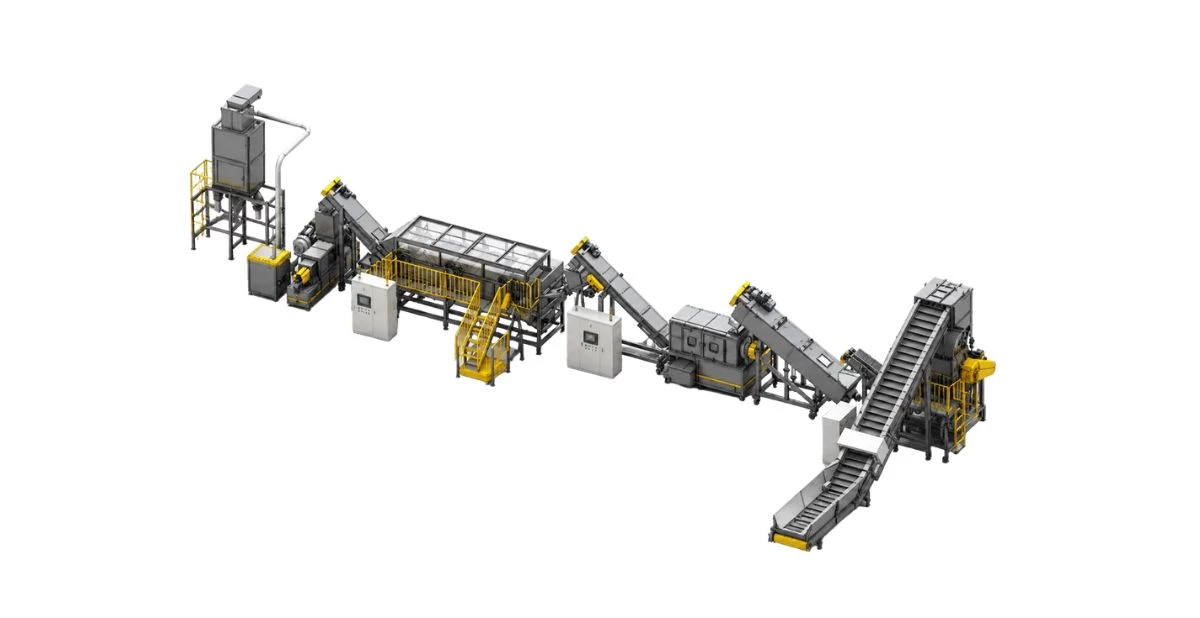
Geording Machinery recently completed installing a complete crushing, washing, and drying line for a recycler in Japan, one of the global plastics industry's most demanding markets for equipment reliability.
Looking back on the project, whether it finished on schedule or stalled at handoff often came down to one thing: whether it was delivered on a turnkey basis, with one supplier accountable from layout through startup.
What Does This Turnkey Crushing, Washing & Drying Installation in Japan Actually Involve?
This project covers the full material path from crushing through washing to drying, delivered under Geording's one-stop support service — including raw material analysis, process design, equipment installation, and operator training — all under a single project contract.
The client is a long-established Japanese recycler running polyethylene (PE) and polypropylene (PP) film scrap, spanning agricultural, packaging, and industrial film sources plus other soft plastic waste streams, through the line to produce clean, dry recycled flakes for downstream manufacturers.
That market typically runs tighter tolerances on moisture control and material consistency than most other regions. Geording's Japan relationships date back to 2006, when the company earned recognition from one of Japan's largest materials suppliers and installed two 3-in-1 pelletizing machines at its factory. Beyond that, Geording has also delivered a joint turnkey demonstration recycling line with a Japanese market leader, demonstrating the company's ability to deliver full-service projects in this market.
The client cited this track record — built over years rather than starting from scratch — plus Geording's one-stop support model covering installation and after-sales service, as the deciding factors over competing bids. That track record is the benchmark Japanese buyers use to judge every new supplier, and it was the bar this project had to clear from day one.
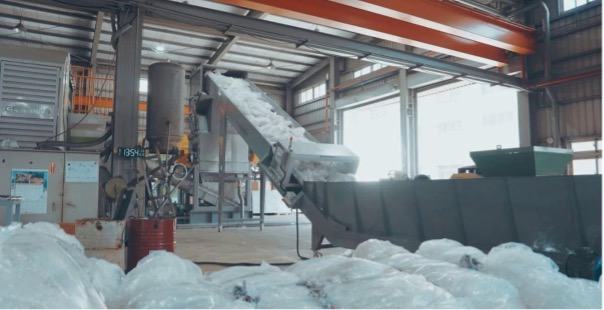
Why Is a Plastic Recycling Plant Installation in Japan Such a High Bar to Clear?
A plastic recycling plant installation in Japan is a direct test of a supplier's execution capability, since Japanese buyers hold recycling equipment to standards that go beyond what most other markets require. According to Japan's Plastic Waste Management Institute, the country generated 7.69 million tons of plastic waste in 2023, and only about 6% of it was recycled and reused domestically.
Since Japan's Plastic Resource Circulation Act took effect in April 2022, local recyclers have faced mounting pressure to prioritize long-term production stability, recycled material quality, and ongoing after-sales support over initial equipment cost. (Geording explores this market shift in greater detail in What Japanese Buyers Really Look for in an OEM Partner.)
Ultimately, Japanese operators consistently look past nameplate specifications toward whether a system holds its performance over continuous production runs, and whether the supplier delivering it can support the equipment for years — not just with brief assistance during commissioning.
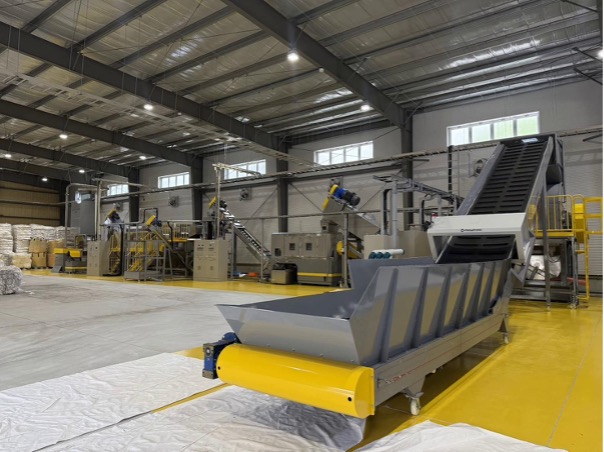
What Does "Reliability, Precision, and Operational Stability" Actually Require in Practice?
In practice, system stability requires three things:
-
Reliability
sustaining output through months of continuous runtime, not just during commissioning -
Precision
producing consistent particle size so wash tanks aren't compensating for uneven feedstock -
Operational stability
keeping moisture output steady even as throughput fluctuates
On this project, Geording tuned the crushing stage to hold a narrower particle-size window than its standard setting, so the wash tanks downstream didn't need an extra pass to compensate for oversized fragments. Meeting that spec on paper is one thing — building it into a line that actually runs reliably is what matters.
How Does a Turnkey Recycling Equipment Installation Come Together On-Site?
Delivering a turnkey system means coordinating layout, sequencing, and commissioning across every stage before a single batch runs through it. On this project, Geording's own installation team managed that coordination directly, so the client didn't need to bring in a separate contractor for line integration.
On this installation, material moves through four linked stages:
- Wet-type crushing — the initial blade impact knocks dust off the raw feedstock before it ever reaches the wash tank, controlling size and cleaning the material in the same step.
- Flotation separation — one to three tanks, with the count set according to how clean the incoming material is, separate contaminants by density.
- Friction washing and dewatering — a horizontal friction washer/dryer combines both functions in a single stage.
- Drying — material moves to the drying stage before continuing downstream (see the full washing line equipment specifications).
Two technologies sit behind that performance: multi-stage friction washing and an intelligent water circulation and filtration system. Together, they cut water use without sacrificing wash consistency — on this Japan installation, the water circulation and filtration system alone cut water use by roughly 30–40%.
Can the Same System Handle Both Compact and Large-Scale Recycling Operations?
The same core system architecture scales from smaller recycling operations to full industrial plant installations.
A buyer's current throughput doesn't lock them into a ceiling. Geording has built film recycling lines ranging from compact 1-ton systems to 25-ton industrial installations across Taiwan, Southeast Asia, South America, and Europe, and applies the same modular approach in Japan — in line with the industry's broader shift toward smart, scalable recycling systems.
So even a plant that starts with a compact configuration can expand capacity later without replacing the underlying system design; the single-screw drying stage, for example, can simply be configured in series to reach higher throughput as the plant grows.
What the Line Delivers: Washing Performance, Moisture Control, and Smooth Downstream Processing
Downstream processing efficiency hinges on three variables: uniform crushing size, thorough contaminant removal, and strict moisture control.
On Geording's standard crushing-washing-drying configuration, the single-screw drying stage can be arranged in series to reach a rated capacity of up to 2,000 kg per hour while keeping power consumption low. In an industry where keeping moisture under 5% is generally difficult to achieve, Geording's centrifugal dewatering stage is rated to bring moisture content down to 3%.
Confirmed figures from this Japan installation:
- Throughput: holding steady at roughly 1,000 kg per hour
- Moisture content: steady at 3%
These weren't paper specs — the client ran repeated trials over multiple rounds before signing off on the order. Excess moisture slows down extrusion, while inconsistent particle sizes cause uneven melt flow. Controlling both variables is what allows the line to run continuously with minimal operator intervention.
On this installation, the client also added a Geording pelletizer downstream of the drying stage, so washed and dried material feeds directly into pelletizing without an intermediate handling step.
Breaking past the limits of single-point equipment — and integrating every stage from crushing through pelletizing under one turnkey system — is what makes consistently low moisture, high material quality, and continuous line performance actually achievable.
Why System Integration Matters for Recycling Plant Buyers
This turnkey installation in Japan makes that trade-off concrete: buying a crushing, washing, and drying system as a turnkey package removes the coordination risk that comes with sourcing each stage separately and integrating them in-house. A single-supplier approach makes accountability clear — if performance falls short, the client works with one point of contact rather than untangling responsibility across several vendors.
Geording has already seen what happens without that kind of single-supplier accountability: in Southeast Asia, a major recycler's existing washing line fell short of its target performance, disrupting delivery schedules, until Geording's engineering team conducted an on-site diagnosis and redesigned the equipment layout and workflow. Geording has seen the same pattern with several buyers as well: prospective clients who first priced out crushing, washing, and drying equipment separately have come back requesting a single turnkey quote once they mapped out the coordination work involved.
Based on that experience, the point where plant capacity outgrows a single-stage setup is often the turning point: managing three separate supplier relationships starts costing more in coordination time than a piecemeal approach saves in unit pricing.
What Should You Ask When Evaluating a Recycling Line Supplier?
When evaluating suppliers for a crushing-washing-drying installation, look beyond unit specifications. Ask:
- Do they deliver on a turnkey basis?
- Who owns integration risk if something underperforms after commissioning?
- Do they have a track record in markets with stricter operational requirements than your own?
Geording's turnkey washing line service is built to the same delivery standard shown in this Japan installation; see the full washing line specifications on our crushing, washing, and drying line page.
On this Japan installation, that plays out in three concrete ways:
- A Japan track record dating back to 2006
- A one-stop service covering everything from process design to operator training
- Single-point accountability instead of the risk of piecemeal sourcing
If you're evaluating a new line, or reconsidering piecemeal purchasing, Geording's team can walk through project-specific requirements with you.