As global sustainability regulations continue to tighten and corporate ESG commitments become more concrete, the plastics industry is entering a new phase of transformation. Instead of eliminating plastic entirely, manufacturers are shifting their focus toward how materials can be reused, recycled, and reintegrated into production systems.
This transition has positioned Post-Consumer Plastic Recycling (PCR Plastic Recycling) as a key strategy in modern manufacturing. Among various materials, polyethylene (PE) and polypropylene (PP), which account for a large share of global plastic usage, have become the primary focus of recycling initiatives.
In 2026, Plastic ESG is no longer just a concept. It has become a measurable requirement. The ability to efficiently recycle PE and PP materials is now directly linked to both environmental performance and long-term competitiveness.
To better understand how Plastic ESG strategies are evolving in 2026, you may also explore: How Can the Plastic Industry Achieve ESG Goals in 2026?
What Is Plastic ESG and Why It Matters in 2026
Plastic ESG refers to how companies manage environmental impact, resource efficiency, and sustainability throughout plastic production and usage.
Several key factors are driving this shift:
- Increasing global regulations on plastic waste and recyclability
- Brand commitments to using recycled content such as PCR materials
- Pressure to reduce carbon footprint across supply chains
- Growing demand for circular economy models
For many industries, especially packaging, consumer goods, and automotive, recycled plastic is no longer optional. It is increasingly becoming a requirement for market access and brand positioning.
As a result, manufacturers are investing in PCR plastic recycling systems to secure a stable supply of high-quality recycled materials.
Why PE and PP Are the Core of Plastic Recycling
Among all plastic materials, PE (polyethylene) and PP (polypropylene) play the most critical role in recycling systems.
Polyethylene Plastic Recycling (PE)
PE is widely used in:
- HDPE containers (drums, bottles, industrial packaging)
- LDPE films (bags, shrink wrap, agricultural films)
Its advantages include high recyclability, strong market demand for recycled PE (rPE), and a wide range of applications after recycling.
Polypropylene Plastic Recycling (PP)
PP is commonly used in:
- Food containers and caps
- Automotive components
- Household and industrial products
Its advantages include stable mechanical properties after recycling, strong demand for recycled PP (rPP), and suitability for closed-loop recycling applications.
Because of their volume, recyclability, and reusability, PE and PP form the backbone of modern Plastic ESG strategies.
What Is the Process of Converting Plastic Waste into rPE and rPP?
The real value of plastic recycling lies not only in waste reduction, but in converting discarded materials into consistent and usable raw materials for production.
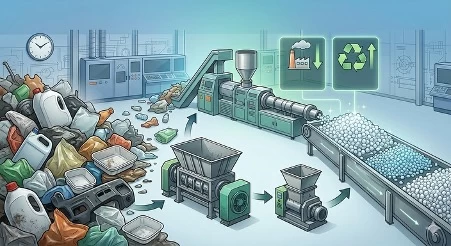
A typical PCR plastic recycling process involves several key stages. Post-consumer plastic waste is first collected and sorted to separate different materials and remove contaminants. The materials are then processed through size reduction, including shredding and crushing, to achieve a uniform input for downstream operations.
Following this, washing systems are used to remove labels, dirt, and residual impurities. The cleaned material is then fed into extrusion systems, where melt filtration ensures that remaining contaminants are removed before pelletizing. The final output is recycled plastic pellets that can be directly reused in manufacturing.
For a deeper understanding of plastic recycling processes and material transformation, see: What is PET recycling? A practical guide from PET bottles to rPET pellets
The result of this process is:
- rPE (recycled polyethylene)
- rPP (recycled polypropylene)
These recycled materials are widely used in applications such as packaging, industrial components, and consumer goods. In many cases, they can partially replace virgin materials without significantly affecting performance.
More importantly, rPE and rPP are becoming part of a stable and scalable supply chain. Manufacturers are adopting these solutions not only to reduce dependence on virgin plastic, but also to meet regulatory requirements, improve ESG performance, and respond to increasing demand for sustainable products.
In this context, recycling is a practical approach to securing material supply and improving long-term production resilience.
What Are the Key Challenges in Post-Consumer Plastic Recycling?
Post-consumer plastic recycling faces several key challenges that directly affect efficiency, output quality, and overall system stability. The most critical issues include material contamination, inconsistent input materials, difficulty in processing large rigid plastics, and maintaining consistent pellet quality.
Material contamination is one of the most common problems. Mixed materials, labels, adhesives, and residual waste can reduce recycling efficiency and lead to lower-quality output if not properly removed.
Inconsistent input materials also affect process stability. Post-consumer plastic waste varies widely in composition, thickness, and cleanliness, making it difficult to maintain stable operating conditions.
Processing large and rigid plastics requires specialized equipment. Items such as HDPE barrels and industrial containers cannot be handled by standard systems and typically require dedicated size reduction solutions.
Quality control remains a critical challenge. To meet downstream manufacturing requirements, recycled pellets must maintain consistent properties in terms of size, purity, and mechanical performance.
These challenges show that plastic recycling is not only a matter of processing waste. It requires a well-designed system that can manage material variability, ensure process stability, and deliver consistent output quality.
How Do Integrated Recycling Solutions Improve ESG Performance?
Integrated recycling solutions improve ESG performance by reducing waste, lowering carbon emissions, increasing resource efficiency, and helping companies meet sustainability regulations. These systems allow manufacturers to convert post-consumer plastic into reusable materials while maintaining stable production quality.
From an operational perspective, recycling systems contribute to several key ESG outcomes.
They reduce landfill waste by diverting plastic materials back into the production cycle instead of disposal.
They lower carbon emissions by replacing virgin plastic with recycled materials, which typically require less energy to produce.
They improve resource efficiency by maximizing material utilization and reducing overall material loss during production.
They also support compliance with sustainability regulations and customer requirements, especially in industries where recycled content is becoming mandatory.
More importantly, recycling should be viewed as a practical investment that supports long-term supply stability, cost control, and ESG performance.
Companies that adopt well-designed recycling solutions can achieve both environmental benefits and measurable operational advantages.
Conclusion
In 2026, Plastic ESG is no longer just a trend. It has become a business requirement that directly affects market access and long-term competitiveness.
Polyethylene and polypropylene recycling play a key role in supporting sustainable manufacturing, improving resource efficiency, and strengthening supply chain stability.
For manufacturers and recyclers, the focus is no longer on whether recycling should be implemented, but on how to build a system that can operate efficiently and deliver consistent material quality.
Choosing the right recycling solution often depends on working with a partner that understands both material behavior and system integration. Solution providers with hands-on experience in PE and PP recycling, such as GEORDING MACHINERY, can support manufacturers in building efficient and scalable recycling systems.
This type of capability becomes increasingly important when dealing with post-consumer materials, where variability is high and process control directly affects final product quality.
Choosing the right rPE and rPP recycling solutions is an important step toward building a reliable and future-ready production system. Well-designed recycling processes can help companies reduce material costs, improve operational control, and meet increasing ESG expectations from customers and regulators.
If you are planning to invest in recycling systems, this guide on how to start a plastic recycling business provides practical insights: How to Start a Recycling Business? Begin by Choosing the Right Equipment for Your Own System
FAQ
Q1: What is PCR plastic recycling?
PCR (Post-Consumer Recycling) refers to the process of collecting, processing, and reusing plastic waste generated by consumers.
Q2: What is the difference between rPE and rPP?
rPE is recycled polyethylene, commonly used in packaging and containers, while rPP is recycled polypropylene, often used in automotive and consumer products.
Q3: Why are PE and PP easier to recycle?
They have simpler chemical structures and are widely used, making collection, sorting, and reprocessing more feasible.
Q4: What equipment is needed for plastic recycling?
Typical systems include shredders, crushers, washing lines, extruders, and pelletizing systems.
Q5: How does plastic recycling support ESG goals?
It reduces waste, lowers carbon emissions, and improves resource efficiency, helping companies meet sustainability targets.