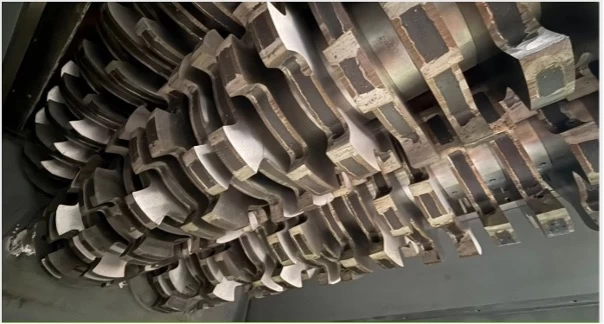
When evaluating high-efficiency material reduction, four-shaft shredders have become the definitive cornerstone of modern waste processing. This explains why forward-thinking recycling plants increasingly rely on this advanced quad-shaft configuration rather than traditional crushing methods. As global recycling standards tighten and input material streams become more unpredictable, selecting a size-reduction system is no longer just about raw horsepower — it is about achieving true operational predictability.
For modern recycling facilities,processing high-volume, mixed waste is a demanding daily battle. Traditional shredding setups often struggle to maintain a smooth, uninterrupted workflow, frequently leading to material jams, unexpected downtime, and erratic production schedules that erode profitability. To thrive in today's competitive circular economy, facilities must shift their focus from aggressive, chaotic crushing to intelligent, controlled material sizing. To understand how to achieve this stability, we must examine how conventional multi-shaft systems often fall short under demanding factory conditions.
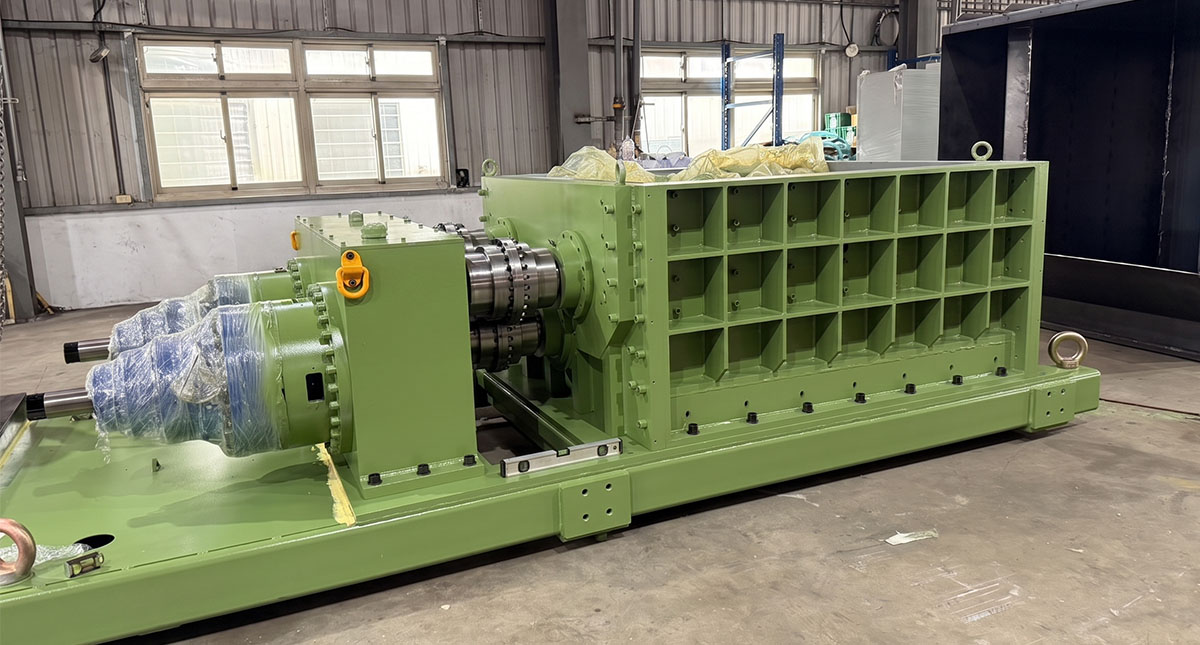
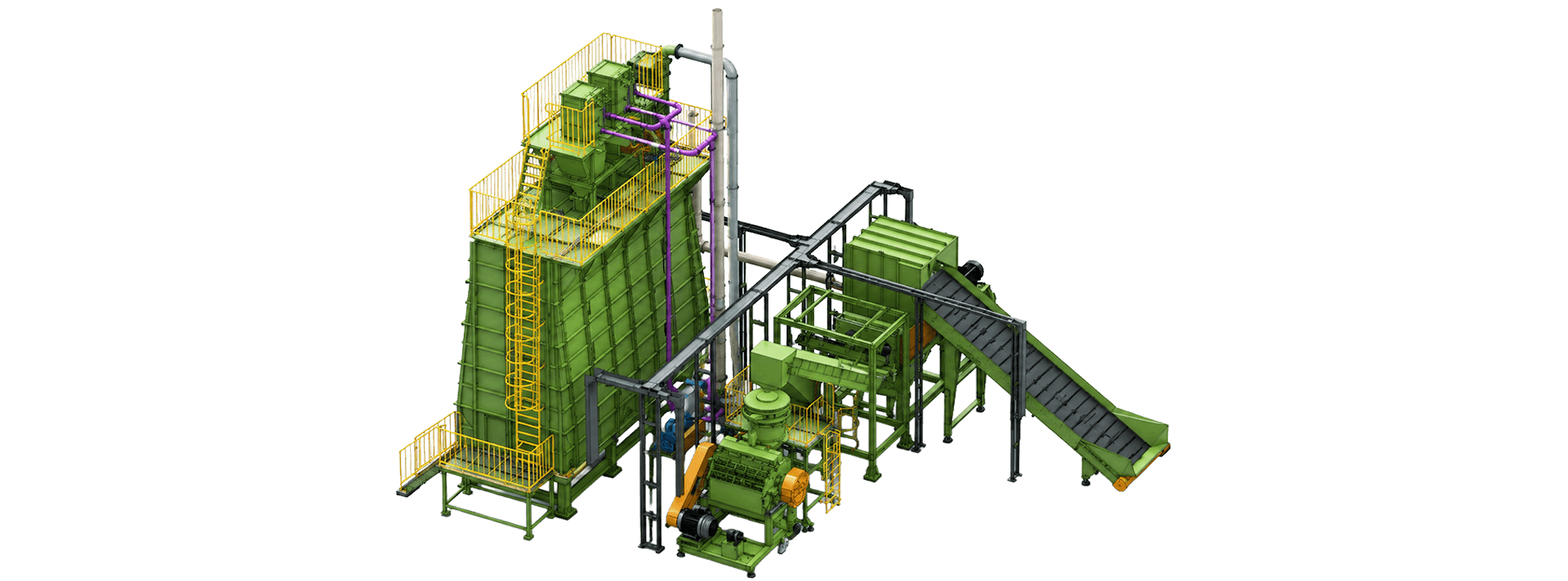
(Geording's GD-QS series quad-shaft shredder: twin electric motor drives, European-made reducers, and precision gearbox couplings mounted on the heavy-duty welded main frame.)
The Technological Evolution: Four-Shaft vs. Twin-Shaft vs. Single-Shaft Shredders
Choosing the right size-reduction platform requires understanding how different shaft configurations interact with complex feedstocks. Each technology serves a distinct operational purpose, but their efficiency varies significantly when uniform particle size is the ultimate goal.
The following comparison matrix highlights the strategic differences between the three major industrial shredder configurations:
| Shredder Type | Cutting Mechanism & Design | Best Suited Applications | Output Sizing Control | Operational Risk Level |
|---|---|---|---|---|
| Single-Shaft Shredder | Uses a single high-speed rotor paired with a hydraulic pusher to press material against counter-knives. | Homogeneous plastics, purges, baled materials, and uniform production scrap. | Good sizing via an under-screen, but prone to frictional heat generation. | High risk of rotor damage or thermal degradation when processing unsorted mixed metals. |
| Twin-Shaft (Dual-Shaft) Shredder | Features two counter-rotating shafts with intermeshing blades that aggressively pull and tear material. | High-volume primary reduction, bulky waste, tires, and initial preprocessing. | Poor. Produces long strips and irregular pieces; requires separate downstream screening. | Low jam risk, but cannot guarantee a final uniform particle in a single pass. |
| Four-Shaft (Quad-Shaft) Shredder | Employs two primary cutting shafts and two upper clearance shafts operating above an integrated screen. | Complex e-waste, hollow plastic drums, mixed industrial scrap, and RDF/SRF production. | Excellent. Guarantees 100% consistent sizing in a single pass via automatic continuous recirculation. | Extremely low. Low-speed, high-torque shearing prevents jamming and thermal stress. |
While single and dual-shaft machines excel in specific, isolated processing roles, they introduce significant bottlenecks when integrated into fully automated lines that demand precision. This technological gap explains why a multi-tasking approach is required for complex, modern waste streams. If your facility primarily processes homogeneous plastics or uniform manufacturing scrap, feel free to explore our Single-Shaft Shredder Performance Guide to discover how to optimize sizing efficiency for single-material recycling.
The Core Advantage: How Four-Shaft Engineering Eliminates the Re-Shredding Loop
Dual-shaft shredders perform exceptionally well for basic volume reduction, but they frequently reach their operational limits when faced with complex feedstocks that require strict, uniform output sizing. A common, costly frustration on the factory floor is the generation of "oversized strips" or irregular pieces that slip through dual-shaft cutting blades. This inconsistency directly violates the need for a consistent output, forcing operators into an inefficient, labor-intensive cycle of re-shredding, where material must be manually collected, hauled back, and fed into the hopper a second time.
Four-shaft shredders eliminate this operational bottleneck through an elegant, automated approach to size classification. By positioning two precision-engineered clearance shafts directly above an interchangeable discharge screen, the system simultaneously executes primary reduction and aggressive shearing in a single pass. Material simply cannot leave the cutting chamber until it is reduced enough to pass through the screen apertures. This automatic recirculation frees your workforce from the tedious loop of re-shredding, bringing a smoother, more human-centric rhythm to your daily plant operations while guaranteeing the flawless downstream synergy your automated line demands.
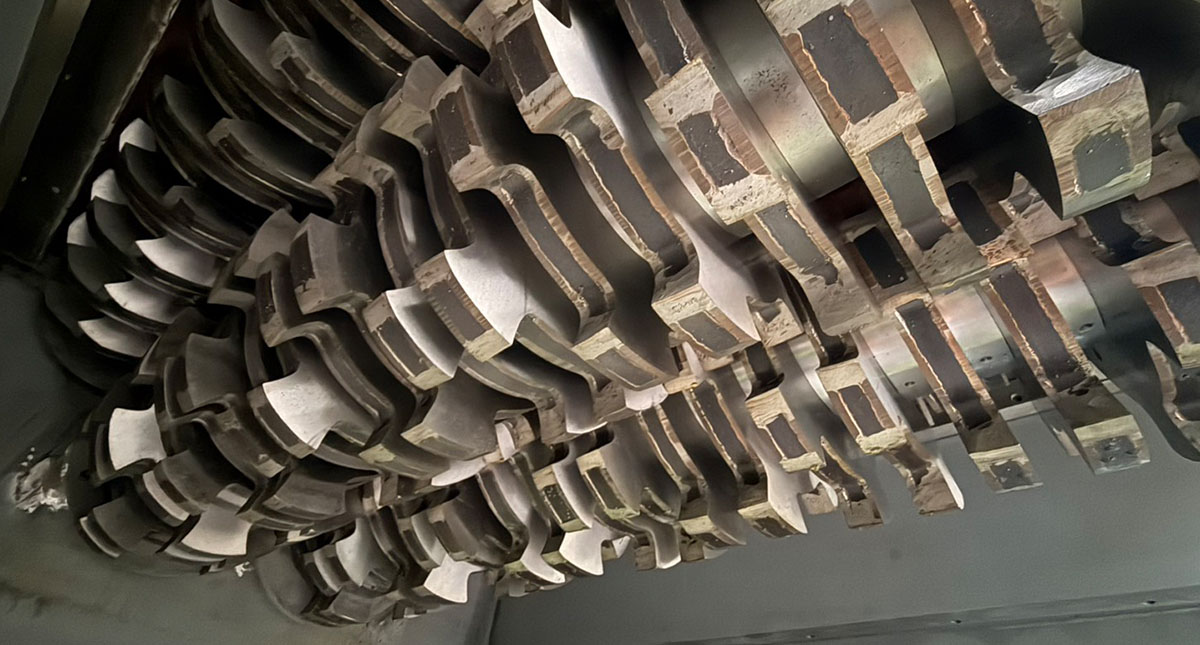
Cutter shaft layout inside the Geording four-shaft shredder: two primary cutting shafts intermesh with two upper clearance shafts above an interchangeable discharge screen — the geometry that drives automatic recirculation until material reaches the target particle size.
Key Industrial Applications: Maximizing Value from Tomorrow's Toughest Waste Streams
Because this technology guarantees a one-step sizing process, a heavy-duty four-shaft shredder is uniquely suited for complex applications where precise material sizing and aggressive primary reduction are required at the same time. Instead of forcing your production team to constantly adapt your workflow to the limitations of a rigid machine, this flexible configuration effortlessly adapts to the diverse, unpredictable nature of modern industrial recycling:
-
Electronic Waste (E-Waste) Processing
Safely and efficiently liberates intricate combinations of precious metals, engineering plastics, and fiberglass found in circuit boards and consumer electronics, creating a perfectly sized feedstock for downstream optical sorting. -
Bulky Plastics & Hollow Drums
Effortlessly captures large, hollow plastic containers and chemical drums that typically slip or bounce around helplessly in traditional shredders, ensuring the blades bite into the material instantly. For operations requiring compliance with strict industrial safety standards, we invite you to learn more about our dedicated Chemical Drum and Industrial HDPE Barrel Recycling Solutions. -
Mixed Industrial Manufacturing Scrap
Handles unpredictable, high-density batches of production scrap containing varying material structures, delivering a uniform output despite the erratic nature of the day's input. -
Alternative Fuel Production (RDF/SRF)
Transforms diverse municipal and industrial waste into homogenous fractions, perfectly prepped for energy recovery processes where consistent particle size is critical for optimal, clean combustion.
From Downtime to 35% Throughput Growth: A Geording Success Story
To understand the tangible impact of this technology, look no further than a recent integration Geording Machinery completed for a major recycling facility in Asia.
-
The Challenge
The client was struggling with high volumes of complex, mixed industrial scrap and E-waste. These volatile materials carried high risks of dust explosions and thermal ignition due to friction during processing. Their existing dual-shaft system lacked safety protection and consistently overheated, forcing the plant into frequent safety shutdowns that severely crippled weekly profitability. -
The Geording Solution
Geording's engineering team integrated a heavy-duty four-shaft shredder, custom-engineered with a fully certified explosion-proof system and spark-extinguishing safeguards, directly into their automated line. -
The Result
The facility achieved a 100% consistent particle size in a single pass while completely mitigating combustion risks. Plant downtime dropped to zero, and the uniform, safe output increased total line throughput by 35%, transforming volatile, high-hazard scrap into a highly profitable, premium commodity stream under maximum safety standards.
Product Spotlight: Geording's Advanced Four-Shaft Shredder Series
Designed with the operator in mind, Geording Machinery's four-shaft shredders balance relentless industrial power with sophisticated, user-friendly engineering. We don't just build machines; we design solutions that fit into the human rhythm of your factory floor.
-
Low-Speed, High-Torque Harmony
Engineered to operate at a lower RPM with massive cutting torque. This means the machine easily shears through heavy metals and thick plastics while keeping factory floor noise levels comfortably low. -
Smart Anti-Jam PLC Intelligence
Equipped with a PLC-controlled forward/reverse system offering multiple operating modes. If an unbreakable foreign object enters the chamber, the shredder automatically reverses to clear the zone — protecting your blades, your gearbox, and your operator's nerves. -
Ergonomic, Quick-Change Screen Design
The interchangeable discharge screens are positioned for easy accessibility, allowing maintenance teams to swap screen sizes swiftly to meet changing client specifications without prolonged downtime. -
Bearing Protection That Stays Out of the Action
Geording mounts the bearings externally — away from the cutting chamber, away from liquid ingress, away from material contact. Combined with European-made bearings, this design pattern substantially extends bearing life and reduces those frustrating mid-shift maintenance interruptions. -
Modular Cutter Blades for Less Maintenance Pain
Each blade is an independent, swappable unit — when wear sets in, your team replaces only what needs replacing, not the entire rotor assembly. The same modular logic supports stacked configurations when your facility scales up throughput later. -
Customized Explosion-Proof Safety Architecture
Engineered specifically for facilities handling volatile materials, hazardous chemical drums, or dust-explosion-prone feedstocks. Geording offers customized integrations including explosion-proof motors, specialized ATEX/NEMA-compliant enclosures, and proactive thermal monitoring systems. By combining low-RPM physical cutting with smart electrical overrides, we eliminate fire hazards to safeguard your workforce and your investment.
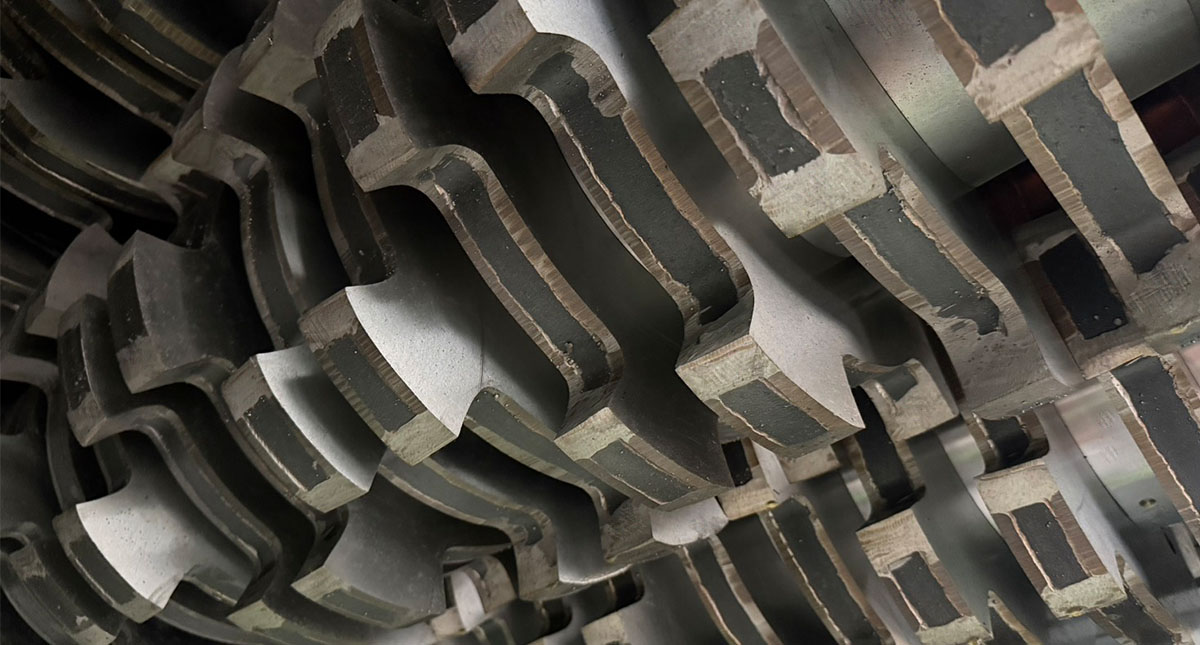
Modular cutter blade assembly. Each blade is an independent, swappable unit — operators replace only worn blades rather than rebuilding the rotor stack, and the same modular logic supports stacked configurations for scaled-up throughput.
Geording GD-QS Series Specifications: Four Models, One Engineering Platform
The Geording quad-shaft shredder is offered in four standard frame sizes, each engineered for a distinct feedstock and throughput requirement. From pre-wash plastic preparation up to municipal solid waste (MSW) handling, the GD-QS series scales from a 37 kW twin-motor entry frame to a 373 kW heavy-industrial flagship. All four models share the same core engineering — twin electric motor drives, European-made reducers, precision gearboxes, externally-mounted bearings, and PLC-controlled auto-reverse — and differ primarily in cutting chamber size, cutter diameter, motor power, and the screen aperture range each frame supports.
| Specification | GD-QS295 | GD-QS365 | GD-QS460 | GD-QS690 |
|---|---|---|---|---|
| Suitable Materials | Plastics, pre-wash | RDF / hard plastics | MSW / mixed industrial waste | MSW / mixed industrial waste |
| Drive Type | Electric motor | Electric motor | Electric motor | Electric motor |
| Four-Shaft (Quad-Shaft) Shredder | Employs two primary cutting shafts and two upper clearance shafts operating above an integrated screen. | Complex e-waste, hollow plastic drums, mixed industrial scrap, and RDF/SRF production. | Excellent. Guarantees 100% consistent sizing in a single pass via automatic continuous recirculation. | Extremely low. Low-speed, high-torque shearing prevents jamming and thermal stress. |
| Drives (qty) | 2 | 2 | 2 | 2 |
| Motor Power | 37–56 kW | 37–75 kW | 93–112 kW | 149–373 kW |
| Reducer | European-made | European-made | European-made | European-made |
| Drive Coupling | Precision gearbox | Precision gearbox | Precision gearbox | Precision gearbox |
| Screen Aperture | 10–80 mm | 10–80 mm | 30–80 mm | 80–150 mm |
| Cutting Chamber | 915 × 787 mm | 1125 × 1015 mm | 1378 × 1320 mm | 2200 × 2075 mm |
| Cutter Rotation Ø | 295 mm | 365 mm | 460 mm | 690 mm |
| Cutter Thickness | 30–80 mm | 30–80 mm | 50–100 mm | 50–100 mm |
Note: All configurations are customizable to specific production requirements. Specifications are updated periodically as the platform evolves — contact Geording with your feedstock profile for the current build options.
Output Particle Size by Screen Aperture
The interchangeable screen system lets operators dial in a specific output particle size by selecting the appropriate aperture. The relationship between screen aperture and resulting output is direct and predictable:
| Screen Aperture | Resulting Output Particle Size |
|---|---|
| 40 mm | 40–60 mm |
| 60 mm | 60–90 mm |
| 80 mm | 80–120 mm |
| 100 mm | 120–150 mm |
This screen-aperture-to-output relationship is one of the practical reasons RDF and SRF producers favor four-shaft platforms: a specific target combustion-grade particle size can be tuned with a single screen change, rather than re-engineering the entire size-reduction line.
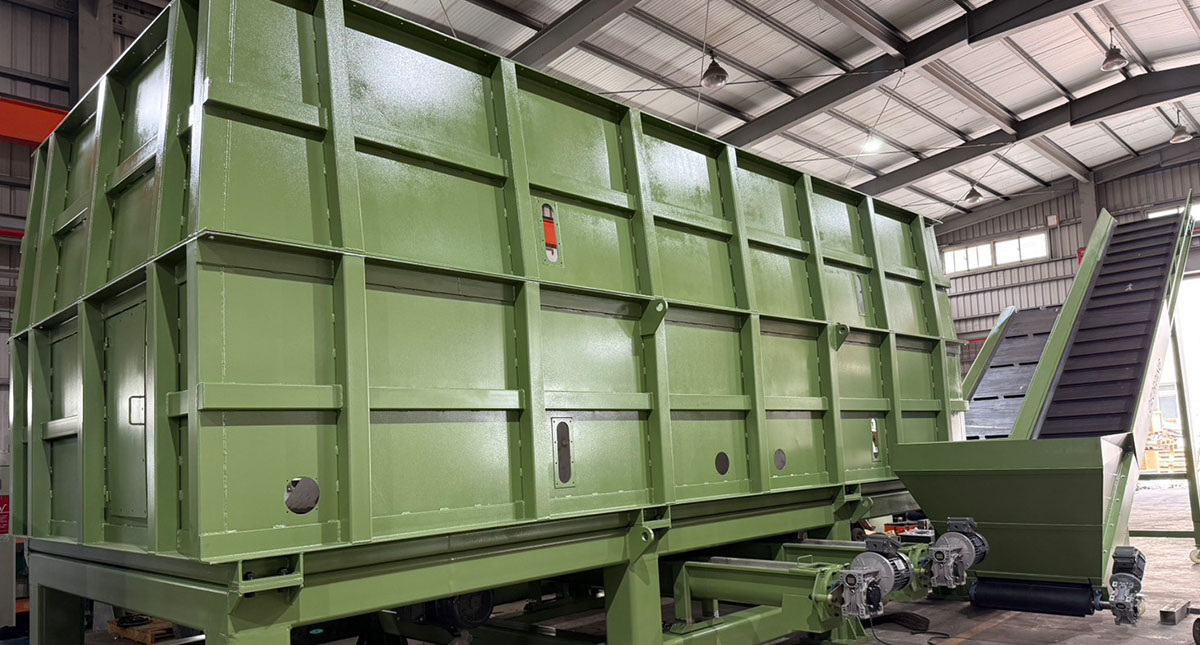
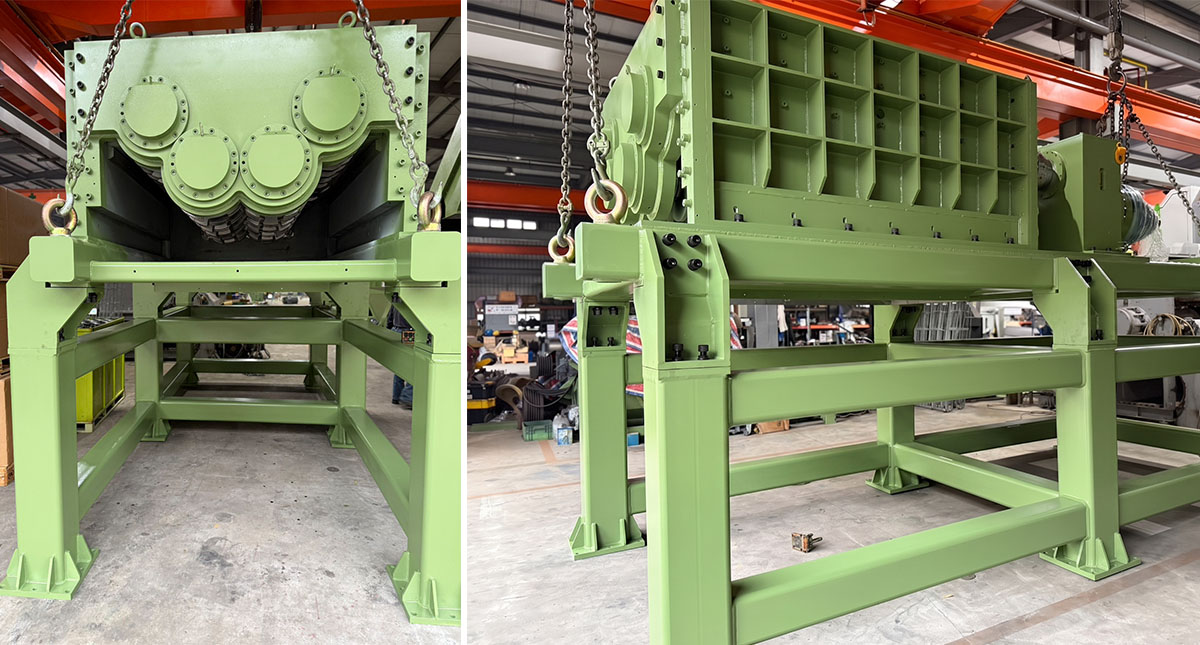
The GD-QS heavy-gauge welded steel main frame is engineered to absorb the vibration and torque of continuous-duty shearing. Externally-mounted bearings sit outside the cutting chamber, isolated from material contact and liquid ingress.
Beyond the Machinery: The Long-Term Strategic Value for Your Enterprise
Investing in advanced size-reduction technology is not just about adding another piece of steel to your factory floor — it is a strategic business decision that optimizes your entire production ecosystem, ensures a consistent output, and protects your bottom line.
By distributing the mechanical cutting loads across four precision-engineered shafts rather than two, the system prevents unnecessary mechanical stress on individual components. This advanced engineering translates directly into minimized operational downtime, as the low-speed, high-torque shearing action handles tough materials without causing unexpected interruptions or excessive knife wear. Ultimately, maximizing the efficiency and throughput of your entire automated line lowers the total cost of ownership (TCO) over time, turning waste management from a variable expense into a predictable, highly profitable asset.
Frequently Asked Questions: Optimizing Your Shredder Selection
To help plant managers and procurement teams navigate their options, Geording Machinery has compiled answers to the most common inquiries regarding modern industrial shredding operations:
-
What is a four-shaft shredder used for?
Four-shaft shredders are used to reduce bulky and mixed industrial waste — plastic drums, scrap metal, end-of-life tires, e-waste, RDF bales — to a uniform particle size in a single pass. The screen-based recirculation distinguishes it from twin-shaft shredders, which produce variable output. -
How is a four-shaft shredder different from a quad-shaft shredder?
They are the same machine. "Four-shaft" is the more common term in Asia and Europe; "quad-shaft" is more common in North American specifications. SSI, Franklin Miller, and Granutech use "quad-shaft"; WEIMA, UNTHA, and most Asian manufacturers (including Geording) use "four-shaft." -
What materials can it process?
Standard configurations process plastics (drums, pallets, frames), light to medium gauge metal, e-waste, tires, paper, wood, and composite materials. Hardened materials, contaminated streams, and hazardous materials require specific blade and frame upgrades. -
What is the throughput?
Throughput depends on frame size, material density, and screen aperture. The Geording GD-QS series spans four frames — from GD-QS295 (37–56 kW, pre-wash plastics) through GD-QS365 (37–75 kW, RDF and hard plastics) and GD-QS460 (93–112 kW, MSW), up to GD-QS690 (149–373 kW, heavy industrial waste). Specific tons-per-hour rates depend on feedstock density and target output size — contact Geording with your material profile for a tested throughput estimate. -
How often do the blades need replacing?
Standard blade life ranges from approximately 200 hours for hard scrap metal to 1,000 hours for clean plastic, depending on feedstock and operating conditions. Geording's modular cutter design allows individual blades to be replaced without rebuilding the entire rotor assembly, which substantially lowers total maintenance cost over the equipment lifetime. -
What is the lead time and warranty?
Standard frame configurations ship within the standard lead time. Custom configurations (explosion-proof, integrated storage tank, alternate blade materials) require longer build cycles.
Partnering with Geording Machinery for Smart, Sustainable Growth
Ultimately, upgrading to a one-step four-shaft sizing solution is about more than just managing waste — this is about positioning your facility for a highly automated, compliant, and sustainable future. To stay ahead of global smart-recycling advancements, don't miss our comprehensive market insight on Waste Recycling Equipment Trends and Closed-Loop Systems. By replacing operational uncertainty with a predictable, consistent output, you safeguard your downstream machinery, empower your workforce, and elevate the market value of your processed commodities.
At Geording Machinery, we believe that every recycling challenge deserves a thoughtful, tailored response rather than a generic, one-size-fits-all product. If you are currently struggling with difficult waste streams, high maintenance costs, or inconsistent output sizes, we invite you to take the next step toward operational efficiency. Contact our technical consulting team today to discuss your production goals, or arrange to send a sample of your toughest feedstock to our facility for custom testing. Let's design a smarter, more efficient material flow together. Explore Geording Machinery's Size-Reduction Solutions.